Nobel Peace Prize Winner Data
This page shows my dataset about the biographic info of Nobel Peace Prize winners and two visualizations that help explain the backgrounds of those winners.
Data Table
Here is a table with 40 rows of the core data used for my charts:
| award_year | known_name | sex | category | birth_date | birth_city | birth_country | death_date | country_winner_rank |
|---|---|---|---|---|---|---|---|---|
| 1901 | Jacobus H. van 't Hoff | male | Chemistry | 1852-08-30 | Rotterdam | the Netherlands | 3/1/1911 | 1 |
| 1901 | Henry Dunant | male | Peace | 1828-05-08 | Geneva | Switzerland | 10/30/1910 | 1 |
| 1901 | Frédéric Passy | male | Peace | 1822-05-20 | Paris | France | 6/12/1912 | 2 |
| 1901 | Wilhelm Conrad Röntgen | male | Physics | 1845-03-27 | Remscheid | Germany | 2/10/1923 | 1 |
| 1901 | Emil von Behring | male | Physiology or Medicine | 1854-03-15 | Lawice | Poland | 3/31/1917 | 1 |
| 1902 | Emil Fischer | male | Chemistry | 1852-10-09 | Euskirchen | Germany | 7/15/1919 | 2 |
| 1902 | Theodor Mommsen | male | Literature | 1817-11-30 | Garding | Germany | 11/1/1903 | 3 |
| 1902 | Élie Ducommun | male | Peace | 1833-02-19 | Geneva | Switzerland | 12/7/1906 | 2 |
| 1902 | Albert Gobat | male | Peace | 1843-05-21 | Tramelan | Switzerland | 3/16/1914 | 3 |
| 1902 | Hendrik A. Lorentz | male | Physics | 1853-07-18 | Arnhem | the Netherlands | 2/4/1928 | 2 |
| 1902 | Pieter Zeeman | male | Physics | 1865-05-25 | Zonnemaire | the Netherlands | 10/9/1943 | 3 |
| 1902 | Ronald Ross | male | Physiology or Medicine | 1857-05-13 | Almora | India | 9/16/1932 | 1 |
| 1903 | Henri Becquerel | male | Physics | 1852-12-15 | Paris | France | 8/25/1908 | 3 |
| 1903 | Bjørnstjerne Bjørnson | male | Literature | 1832-12-08 | Kvikne | Norway | 4/26/1910 | 1 |
| 1903 | Randal Cremer | male | Peace | 1828-03-18 | Fareham | United Kingdom | 7/22/1908 | 1 |
| 1903 | Niels Ryberg Finsen | male | Physiology or Medicine | 1860-12-15 | Thorshavn | Faroe Islands (Denmark) | 9/24/1904 | 1 |
| 1903 | Pierre Curie | male | Physics | 1859-05-15 | Paris | France | 4/19/1906 | 4 |
| 1903 | Marie Curie | female | Physics | 1867-11-07 | Warsaw | Poland | 7/4/1934 | 2 |
| 1903 | Svante Arrhenius | male | Chemistry | 1859-02-19 | Vik | Sweden | 10/2/1927 | 1 |
| 1904 | Sir William Ramsay | male | Chemistry | 1852-10-02 | Glasgow | Scotland | 7/23/1916 | 1 |
| 1904 | Frédéric Mistral | male | Literature | 1830-09-08 | Maillane | France | 3/25/1914 | 5 |
| 1904 | José Echegaray | male | Literature | 1832-04-19 | Madrid | Spain | 9/4/1916 | 1 |
| 1904 | Lord Rayleigh | male | Physics | 1842-11-12 | Langford Grove, Maldon, Essex | United Kingdom | 6/30/1919 | 2 |
| 1904 | Ivan Pavlov | male | Physiology or Medicine | 1849-09-14 | Ryazan | Russia | 2/27/1936 | 1 |
| 1905 | Henryk Sienkiewicz | male | Literature | 1846-05-05 | Wola Okrzejska | Poland | 11/15/1916 | 3 |
| 1905 | Philipp Lenard | male | Physics | 1862-06-07 | Bratislava | Slovakia | 5/20/1947 | 1 |
| 1905 | Adolf von Baeyer | male | Chemistry | 1835-10-31 | Berlin | Germany | 8/20/1917 | 4 |
| 1905 | Robert Koch | male | Physiology or Medicine | 1843-12-11 | Clausthal-Zellerfeld | Germany | 5/27/1910 | 5 |
| 1905 | Bertha von Suttner | female | Peace | 1843-06-09 | Prague | Czech Republic | 6/21/1914 | 1 |
| 1906 | Henri Moissan | male | Chemistry | 1852-09-28 | Paris | France | 2/20/1907 | 6 |
| 1906 | Giosuè Carducci | male | Literature | 1835-07-27 | Val di Castello | Italy | 2/16/1907 | 1 |
| 1906 | Theodore Roosevelt | male | Peace | 1858-10-27 | New York, NY | USA | 1/6/1919 | 1 |
| 1906 | J.J. Thomson | male | Physics | 1856-12-18 | Cheetham Hill | United Kingdom | 8/30/1940 | 3 |
| 1906 | Camillo Golgi | male | Physiology or Medicine | 1843-07-07 | Corteno | Italy | 1/21/1926 | 2 |
| 1906 | Santiago Ramón y Cajal | male | Physiology or Medicine | 1852-05-01 | Petilla de Aragón | Spain | 10/17/1934 | 2 |
| 1907 | Eduard Buchner | male | Chemistry | 1860-05-20 | Munich | Germany | 8/13/1917 | 6 |
| 1907 | Rudyard Kipling | male | Literature | 1865-12-30 | Mumbai | India | 1/18/1936 | 2 |
| 1907 | Ernesto Teodoro Moneta | male | Peace | 1833-09-20 | Milan | Italy | 2/10/1918 | 3 |
| 1907 | Louis Renault | male | Peace | 1843-05-21 | Autun | France | 2/8/1918 | 7 |
Visualization 1
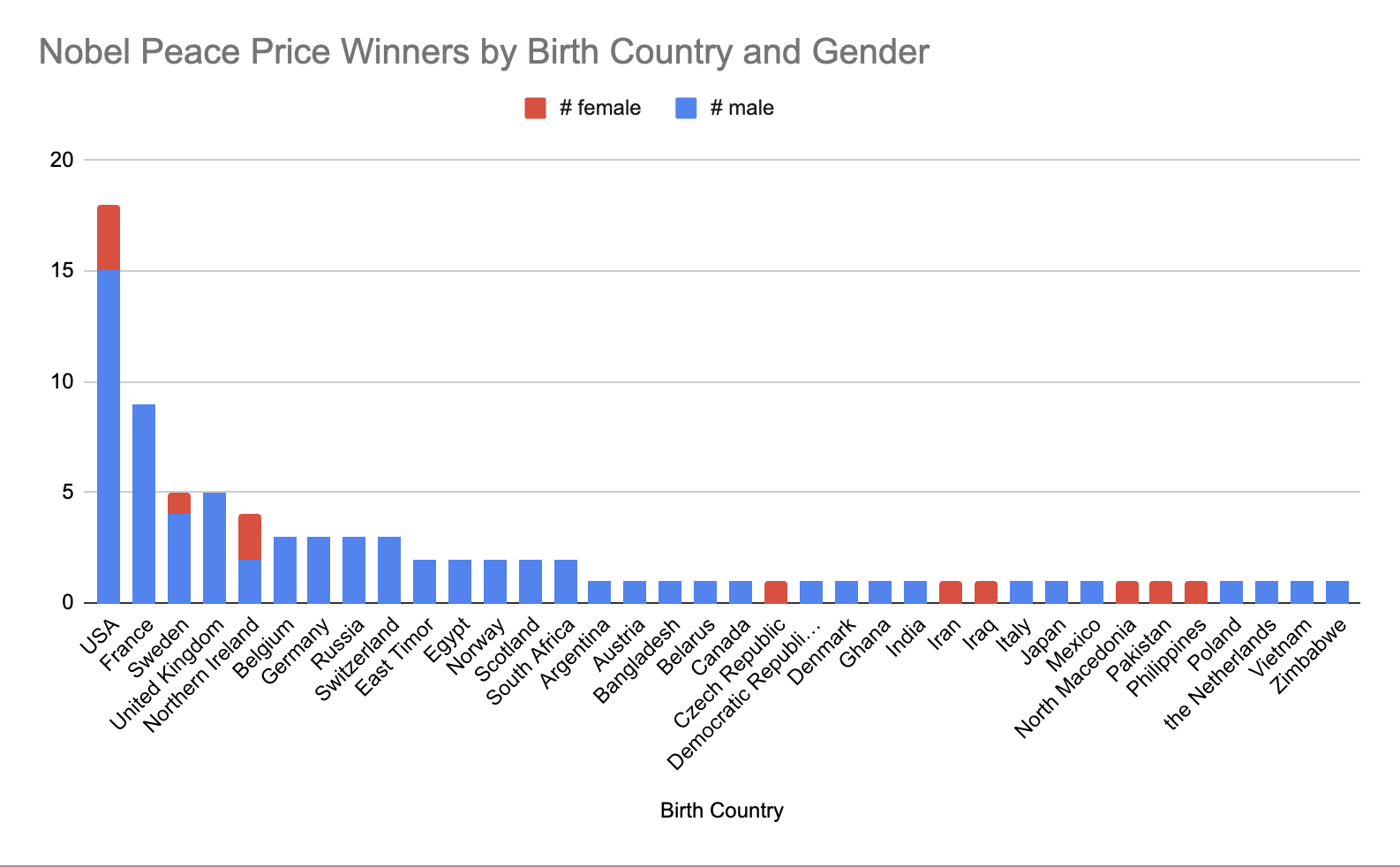
This visualization highlights Peace Prize winners by birth country and gender. Through this analysis, we can see the distribution of gender (there are way more males than females), and the breakdown for each country. Note: this visulization was made from a wider data set of over 80 winners.
Visualization 2

This chart shows the countries of origin for NPP winners and highlights how they’re distributed globally. It allows us to see whether certain countries produce more winners and to compare the counts across regions. Even with a sample of just 40, we can already see that 15% of the winners are from France and another 15% are from Germany.